
72.3% raw “Permit Finaled”
11,155 of 15,426 bathroom-remodel permit records more than 24 months old carried the raw City status “Permit Finaled” at the 2026-10-04 cutoff.
Original research
An original study of 21,798 City of Los Angeles bathroom-remodel permit records and their inspection histories, frozen at a 2026-10-04 data cutoff. Prepared by Bath Remodeling Los Angeles in October 2026; this is not an official City report.
11,155 of 15,426 bathroom-remodel permit records more than 24 months old carried the raw City status “Permit Finaled” at the 2026-10-04 cutoff.
3,009 of the same 15,426 mature records still carried the raw City status “Issued”. These labels are not completion odds, quality grades or proof that work stopped.
• 21,798 permit records are in the study. 9,645 are Tier A (bathroom-specific or wet-space remodels) and 12,153 are Tier B (mixed or broader projects that explicitly include bathroom work). The study covers the City of Los Angeles only. (LADBS pi9x-tg5x; study classifier)
• Record age changes the picture. Among records 0–6 months old (1,858), 29.3% carried "Permit Finaled" and 69.6% carried "Issued." Among records more than 24 months old (15,426), the shares were 72.3% and 19.5%. (LADBS pi9x-tg5x)
• Bathroom-only and mixed-scope permits have different record timeline summaries. Among mature records with an exact "Permit Finaled" inspection result, the median time from issue date to that result was 97 days for Tier A (n = 4,179) and 197 days for Tier B (n = 5,379). This is a permit-record interval, not construction time. (LADBS pi9x-tg5x + 9w5z-rg2h)
• "Final" is the most common inspection type, recorded for 15,647 of the 19,223 permits with matched inspection data (81.4%). "Shower Pan" appeared for 8,786 (45.7%). (LADBS 9w5z-rg2h)
• The first recorded result is often not a verdict. "Approved" was the first raw result for 64.8% of Shower Pan, 45.4% of PLUMBING-Rough and 48.4% of ELECTRICAL-Rough permit/type pairs. Much of the rest is scheduling, cancellation, readiness, partial-approval and correction labels. These figures are not pass rates. (LADBS 9w5z-rg2h)
• “Corrections Issued” appears in the records. At least one such label appeared on 26.1% of Final, 18.6% of PLUMBING-Rough, 16.4% of ELECTRICAL-Rough and 7.0% of Shower Pan permit/type pairs. These are record patterns, not failure or defect rates. (LADBS 9w5z-rg2h)
• 88.2% of permits (19,223) matched at least one inspection row; 2,575 did not. This measures how well the two datasets joined. It is not an inspection-compliance rate. (LADBS pi9x-tg5x ↔ 9w5z-rg2h)
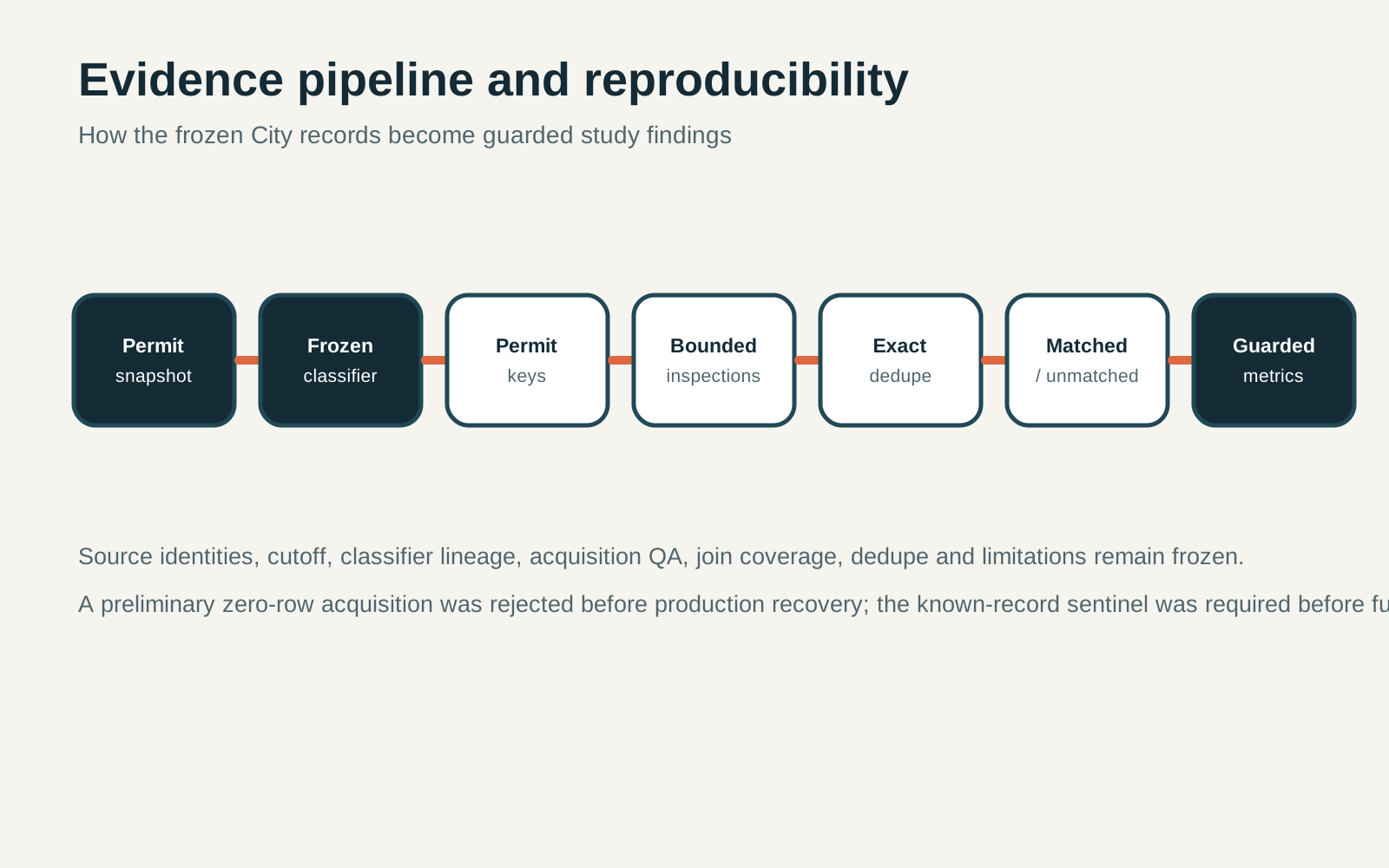
This study looks at what happens after a bathroom-remodel permit is issued in the City of Los Angeles, using only the City's own records. A documented, audited classifier identified 21,798 bathroom-remodel records in a frozen snapshot of the LADBS permit dataset. We joined them to LADBS inspection events dated on or before October 4, 2026.
Three lessons run through the findings.
Age comes before everything. Young records mostly read "Issued" and mature records mostly read "Permit Finaled." The mature share barely moves whether "mature" starts at 12, 18 or 24 months.
Scope is visible in the record. In the frozen descriptive data, mixed or broader permits (Tier B) show a longer permit-record lifecycle summary in the frozen descriptive data and a lower mature "Permit Finaled" share than bathroom-only permits (Tier A). The records show the difference but do not explain it.
The record resists simple verdicts. First inspection results include scheduling, cancellation, readiness and partial-approval labels. "Corrections Issued" appears often. Inspection journeys form a long tail, not a single standard path.
Taken together, the City record is a strong starting point for questions about a bathroom remodel. On its own, it is not a final answer. The due-diligence section below turns that into a five-step checklist for owners and buyers.
Read this table before quoting any figure from this study. The right-hand column lists claims these records cannot support.
| What the records can show | What the records cannot establish |
|---|---|
| Which raw status label (for example "Issued" or "Permit Finaled") a permit record carried at the cutoff | Whether the work is finished, abandoned, defective or noncompliant |
| How many calendar days passed between a permit's issue date and its first exact "Permit Finaled" inspection result | How long construction took, how long a crew worked, or how long a homeowner waited |
| Which inspection types were recorded for matched permits, and how many permits had each type | Which inspections every bathroom remodel requires |
| The first raw result recorded for an inspection type, using the City's own labels | An inspection "pass rate" or "first-time pass rate" |
| Whether a "Corrections Issued" label appeared at least once for an inspection type | Whether anyone was at fault, or whether workmanship was defective |
| Common day-level sequences of inspection types | A complete map of every possible inspection path, or the order of inspections within a single day |
| Whether a permit matched any inspection row in the frozen snapshot | That a permit with no matched row had no inspections |
| Patterns across City of Los Angeles permits | Anything about other cities in Los Angeles County or areas the County itself permits |
| — | Project cost, contractor quality, or neighborhood-level risk |
| — | Why a particular permit is open or finaled |
| — | A permit's status today. The data is frozen at the cutoff, so check the live record. |
Source note: Boundaries come from the frozen evidence and the scope of the two LADBS datasets.
Six terms carry most of the meaning.
• Permit record. One row in the LADBS Building Permits Issued dataset (pi9x-tg5x), identified by its permit number. We describe what the record says, not what happened on site.
• Raw label. A value exactly as the City wrote it, such as "Issued," "Permit Finaled," "Approved" or "PLUMBING-Rough." We never rename them.
• Matched permit. A permit with at least one inspection row in the LADBS Building and Safety Inspections dataset (9w5z-rg2h) on or before the cutoff, joined by permit number.
• Permit/type pair. One permit combined with one inspection type. A permit with several Shower Pan rows is still one Shower Pan pair.
• Mature record. A record old enough at the cutoff that its status says less about how recently it was issued. The primary threshold is 24 months.
• Permit-record lifecycle. The calendar days from a permit's issue date to the earliest inspection row whose result is exactly "Permit Finaled." It describes paperwork, not construction.
Every figure below is a study-derived statistic: the labels are the City's, the counting is ours.
This study's cohort is 21,798 City of Los Angeles permit records. A frozen, audited classifier selected them from the permit dataset's work descriptions. They split into two cohorts that are always reported separately: 9,645 Tier A records and 12,153 Tier B records.
Two tiers, never blended.
Tier A — bathroom-specific or wet-space remodels (9,645 records). These are records whose work description explicitly names a bathroom or bath remodel, renovation or alteration. Tier A also includes tub-to-shower or shower/tub replacement work when the description clearly represents a bathroom remodel.
Tier B — mixed or broader remodels that explicitly include bathroom work (12,153 records). These include kitchen-and-bath descriptions and wider interior remodels that name the bathroom. Records whose bathroom work came bundled with materially mixed exterior scope were also placed here rather than in Tier A.
Why keep them apart? Bathroom-only and mixed-scope permits are different kinds of record, and the frozen results differ across both the permit-record lifecycle summaries and the mature "Permit Finaled" shares. A blended average would describe neither.
What is deliberately excluded.
The classifier is designed to isolate permit records for remodeling existing bathrooms within the frozen one- or two-family dwelling scope. It excludes:
• new buildings, and ADU or new-dwelling work where a bathroom is only an incidental mention;
• new bathroom creation, such as converting a closet, laundry room, storage space or garage into a bathroom;
• broad structural additions with material non-bathroom scope;
• records explicitly marked as supplemental, revision or amendment filings, so one project is not counted twice;
• permits outside the "1 or 2 Family Dwelling" sub-type;
• records with no bathroom signal, and records left unresolved in review.
The methodology and reproducibility section describes how the classifier was built, audited and frozen. The frozen version applies to this specific snapshot only.
City of Los Angeles only.
Both datasets come from the City of Los Angeles Department of Building and Safety. Permits issued by other jurisdictions in Los Angeles County, whether independent cities or the County itself, are not in these datasets. Nothing in this study should be read as describing bathroom remodels countywide.
| Classifier cohort | Permit records | What it contains |
|---|---|---|
| Tier A | 9,645 | Bathroom-specific / wet-space remodels |
| Tier B | 12,153 | Mixed or broader remodels that explicitly include bathroom work |
| Total study cohort | 21,798 | City of Los Angeles records, frozen cutoff 2026-10-04 |
Source note: City of Los Angeles / LADBS, Building Permits Issued (resource pi9x-tg5x), frozen snapshot. Tier assignment is a study-derived classification (classifier v0.4) of the City's work-description text. It is not a City field.
The frozen classifier keeps bathroom-specific Tier A records separate from broader Tier B records that explicitly include bathroom work.
| Cohort | Permit records |
|---|---|
| Tier A | 9,645 |
| Tier B | 12,153 |
A permit record's raw status varies sharply with its age. Among records 0–6 months old, 29.3% carried "Permit Finaled" and 69.6% carried "Issued." Among records more than 24 months old, 72.3% carried "Permit Finaled" and 19.5% carried "Issued." Recent and mature records should never be compared as if they had had the same time to progress.
| Record age at cutoff | Records | Raw status "Permit Finaled" | Raw status "Issued" |
|---|---|---|---|
| 0–6 months | 1,858 | 545 (29.3%) | 1,293 (69.6%) |
| More than 24 months | 15,426 | 11,155 (72.3%) | 3,009 (19.5%) |
Shares in each row do not add up to 100%. Other raw status labels exist and are not itemized in this release. The published summary covers the youngest and oldest age bands; the intermediate bands are not part of it.
Source note: City of Los Angeles / LADBS, Building Permits Issued (resource pi9x-tg5x), frozen snapshot. Record age is measured at the 2026-10-04 cutoff. Status is the raw label in the permit record. The study design reads it from the permit dataset's status field and uses inspection-side permit status only as a reconciliation check. Counts and shares are study-derived.
Read this correctly: These shares are a snapshot of labels on one date. They are not the probability that a permit will be finaled, a grade for the work, or evidence of why any permit is open.
Why age comes first.
A permit issued a few weeks before the cutoff has had little time to collect inspections, so its status says more about its age than about the project. This is right-censoring: for recent records, the outcome is not yet observable. That is why recent and mature records are reported separately.
Tier A and Tier B among mature records.
| Mature records (more than 24 months old) | Records | Raw status "Permit Finaled" |
|---|---|---|
| Tier A | 6,674 | 5,036 (75.5%) |
| Tier B | 8,752 | 6,119 (69.9%) |
Source note: as above; Tier assignment is study-derived (classifier v0.4).
In the mature cohort, Tier A records carried "Permit Finaled" more often than Tier B records. The data records that gap but cannot explain it, so this study offers no cause.
A robustness check: where "mature" begins.
Any line between "recent" and "mature" is a choice. To test whether that choice drives the result, we recomputed the raw "Permit Finaled" share at three thresholds:
| Records at least this old at cutoff | Raw "Permit Finaled" share |
|---|---|
| 12 months | 71.2% |
| 18 months | 71.9% |
| 24 months | 72.3% |
The share moves only within a narrow range (71.2% to 72.3%), so the main conclusion does not hinge on where the line is drawn.
Source note: City of Los Angeles / LADBS, pi9x-tg5x, frozen snapshot; study-derived sensitivity analysis.
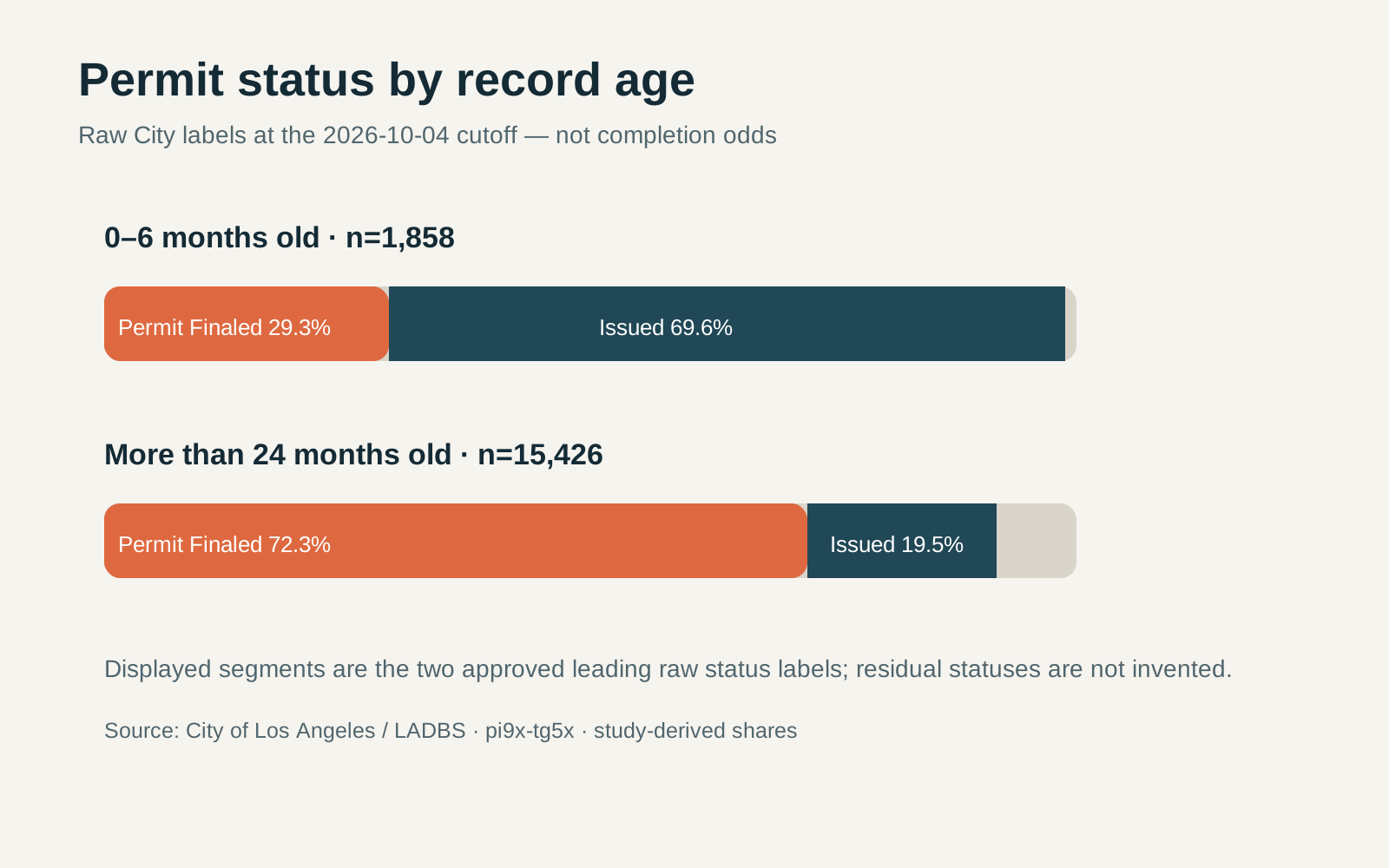
| Record age | Records | Permit Finaled | Issued |
|---|---|---|---|
| 0–6 months old | 1,858 | 545 (29.3%) | 1,293 (69.6%) |
| More than 24 months old | 15,426 | 11,155 (72.3%) | 3,009 (19.5%) |
This is a permit-record lifecycle — not construction duration. It counts the calendar days between a permit's issue date and the earliest inspection row whose raw result is exactly "Permit Finaled." It does not measure how long a remodel took, how long a crew worked, or how long a homeowner waited.
Among mature records (at least 24 months old at the cutoff) with an exact "Permit Finaled" result, the median permit-record lifecycle was 97 days for Tier A (n = 4,179) and 197 days for Tier B (n = 5,379). The middle half of Tier A records fell between 58.5 and 179 days. For Tier B, the middle half fell between 113 and 357.5 days.
| Mature cohort (at least 24 months old) | Records with an exact "Permit Finaled" result | 25th percentile | Median | 75th percentile |
|---|---|---|---|---|
| Tier A | 4,179 | 58.5 days | 97 days | 179 days |
| Tier B | 5,379 | 113 days | 197 days | 357.5 days |
Source note: City of Los Angeles / LADBS. Issue date from Building Permits Issued (pi9x-tg5x). "Permit Finaled" event date from Building and Safety Inspections (9w5z-rg2h), events on or before 2026-10-04. Study-derived interval in calendar days: earliest inspection date with result exactly "Permit Finaled," minus issue date. Permit-record lifecycle, mature ≥24-month cohort, tiers reported separately.
How to use these numbers, and how not to.
• Keep the tiers apart. The two tier-specific lifecycle summaries differ. A single blended figure would describe neither bathroom-only nor mixed-scope permits.
• Don't apply a median to one permit. The middle halves of the two distributions overlap (Tier A: 58.5–179 days; Tier B: 113–357.5 days), and half of all records fall outside those ranges. A median describes a group, not your project.
• Remember who is counted. These figures describe records that did reach an exact "Permit Finaled" result by the cutoff. Records still open at the cutoff are not in this distribution, and if some final later their intervals will be long. Read the figures as completed record lifecycles, not as a forecast for an open permit.
• Don't quote this as "how long a bathroom remodel takes." Neither the issue date nor the records event marks the start or end of construction.
Why there is no single all-years headline.
A median across every issue year would mix mature records with recent ones that have not had time to final. Because recent records are right-censored, a pooled figure would over-represent the short intervals they have had time to show, and it would also blend two separately reported tiers. This study therefore reports only the mature cohort, tier by tier.
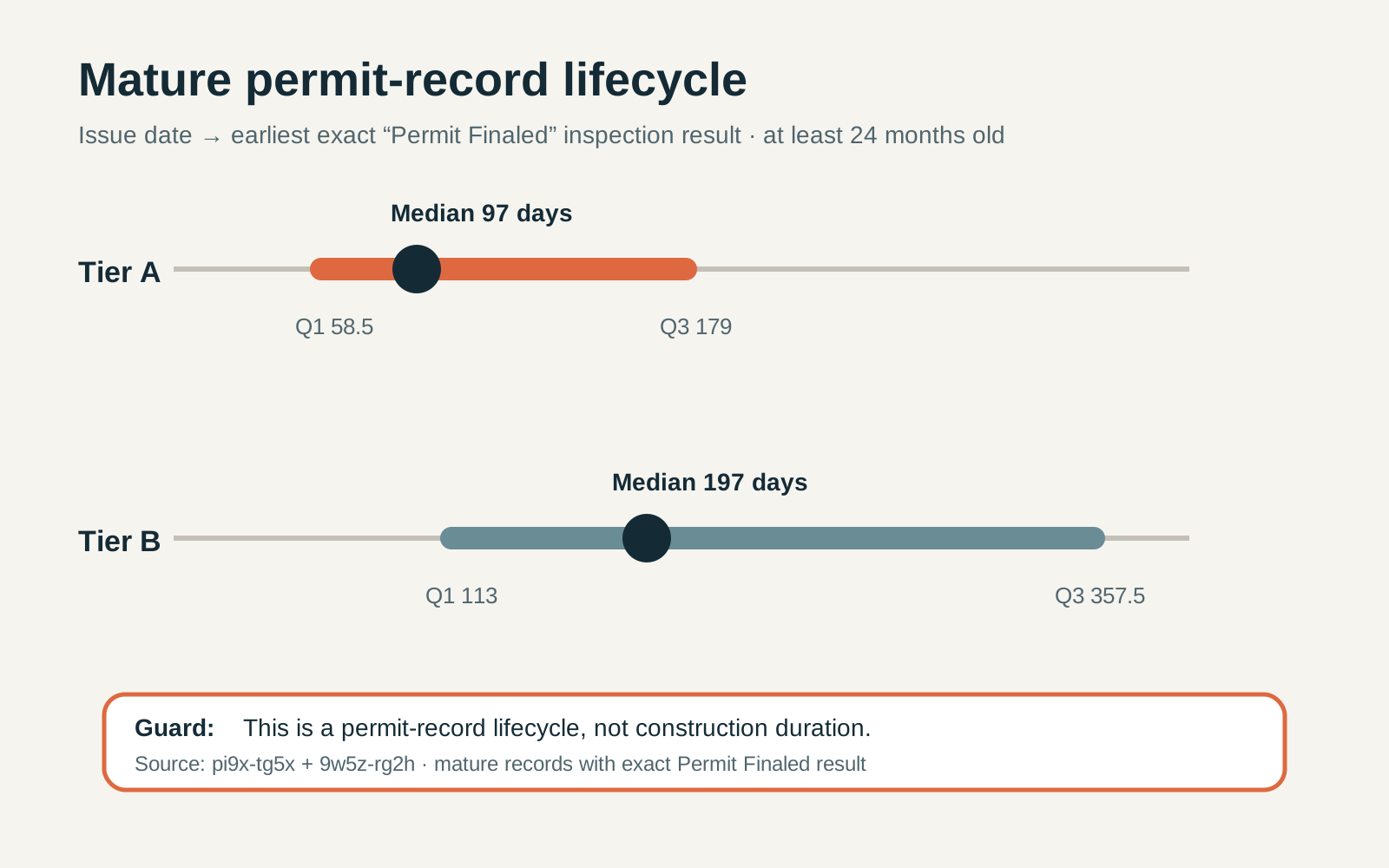
| Cohort | Records | 25th percentile | Median | 75th percentile |
|---|---|---|---|---|
| Tier A | 4,179 | 58.5 days | 97 days | 179 days |
| Tier B | 5,379 | 113 days | 197 days | 357.5 days |
Among the 19,223 permits with matched inspection data, "Final" was the most common inspection type, recorded for 15,647 permits (81.4%). Next came Interior/Exterior Lathing (63.3%), PLUMBING-Rough (59.9%) and ELECTRICAL-Rough (53.6%). Drywall Nailing (46.5%), Shower Pan (45.7%) and Smoke Detectors (40.1%) complete the top seven.
| Rank | Inspection type (raw City label) | Permits with this type | Share of 19,223 matched permits |
|---|---|---|---|
| 1 | Final | 15,647 | 81.4% |
| 2 | Interior/Exterior Lathing | 12,161 | 63.3% |
| 3 | PLUMBING-Rough | 11,507 | 59.9% |
| 4 | ELECTRICAL-Rough | 10,305 | 53.6% |
| 5 | Drywall Nailing | 8,934 | 46.5% |
| 6 | Shower Pan | 8,786 | 45.7% |
| 7 | Smoke Detectors | 7,712 | 40.1% |
Source note: City of Los Angeles / LADBS, Building and Safety Inspections (9w5z-rg2h), events on or before 2026-10-04, joined to the study cohort by permit number. Study-derived: count of matched permits with at least one row of each raw inspection type. Each permit counts once per type, however many rows it has.
Why we count permits, not inspection rows.
One permit can collect several rows of the same inspection type. Ranking by raw row counts would push types that tend to repeat up the list. Counting each permit once per type answers a cleaner question: how many bathroom-remodel permits involved this type of inspection at all?
Read this correctly: A type's frequency here does not mean every bathroom remodel requires it. Even "Final" is absent from some matched records. This list shows what the records contain, not a checklist of what the City mandates for a given project.
The labels are reproduced exactly as the City records them. This study does not define what each inspection examines. For that, consult LADBS directly.
Counts use permits containing each raw inspection type, not raw event-row totals. Frequency does not mean universally required. Base: 19,223 matched permits.
| Inspection type | Permits with type |
|---|---|
| Final | 15,647 |
| Interior/Exterior Lathing | 12,161 |
| PLUMBING-Rough | 11,507 |
| ELECTRICAL-Rough | 10,305 |
| Drywall Nailing | 8,934 |
| Shower Pan | 8,786 |
| Smoke Detectors | 7,712 |
For each permit and inspection type, we looked at the first result the City recorded. "Approved" was the first raw result for 64.8% of Shower Pan pairs, 45.4% of PLUMBING-Rough pairs and 48.4% of ELECTRICAL-Rough pairs. The rest is spread across scheduling, cancellation, readiness, partial-approval and correction labels. That spread is why this study reports raw labels instead of a pass rate.
| First-observed raw result | Shower Pan (8,786 pairs) | PLUMBING-Rough (11,507 pairs) | ELECTRICAL-Rough (10,305 pairs) |
|---|---|---|---|
| Approved | 5,694 (64.8%) | 5,221 (45.4%) | 4,989 (48.4%) |
| Insp Scheduled | 1,143 (13.0%) | 1,520 (13.2%) | 1,386 (13.4%) |
| Corrections Issued | 498 (5.7%) | 1,600 (13.9%) | 1,297 (12.6%) |
| Not Ready for Inspection | 473 (5.4%) | — | 848 (8.2%) |
| Insp Cancelled | 412 (4.7%) | 827 (7.2%) | 732 (7.1%) |
| Partial Approval | — | 914 (7.9%) | — |
"—" means the label was not among the five most frequent first-observed results for that inspection type in the published summary. It does not mean zero. Columns do not add up to 100%: other raw labels, including MULTIPLE_SAME_DAY where it applies, are not itemized.
Source note: City of Los Angeles / LADBS, Building and Safety Inspections (9w5z-rg2h), events on or before 2026-10-04. Study-derived: for each matched permit/type pair, the raw result on the earliest inspection date for that type. Labels are the City's raw values, preserved without mapping.
Why this is not a "first-time pass rate".
It is tempting to read the "Approved" row as a pass rate. Don't. Several of the most frequent first labels, including "Insp Scheduled," "Insp Cancelled" and "Not Ready for Inspection," do not on their face read as either an approval or a rejection of the work. "Partial Approval" is neither a full approval nor a rejection. Turning these into pass/fail would require a validated mapping of every City result label. This study has not built or approved one.
The comparison across types still describes the records: "Approved" came first more often for Shower Pan (64.8%) than for PLUMBING-Rough (45.4%) or ELECTRICAL-Rough (48.4%). The data does not say why.
When several results land on the same day.
Sometimes the City records more than one result for the same permit and inspection type on the earliest date. The study works with dates, so it does not pick a "winner": those first observations are labeled MULTIPLE_SAME_DAY, reported separately where they occur, and not among the five labels shown above.
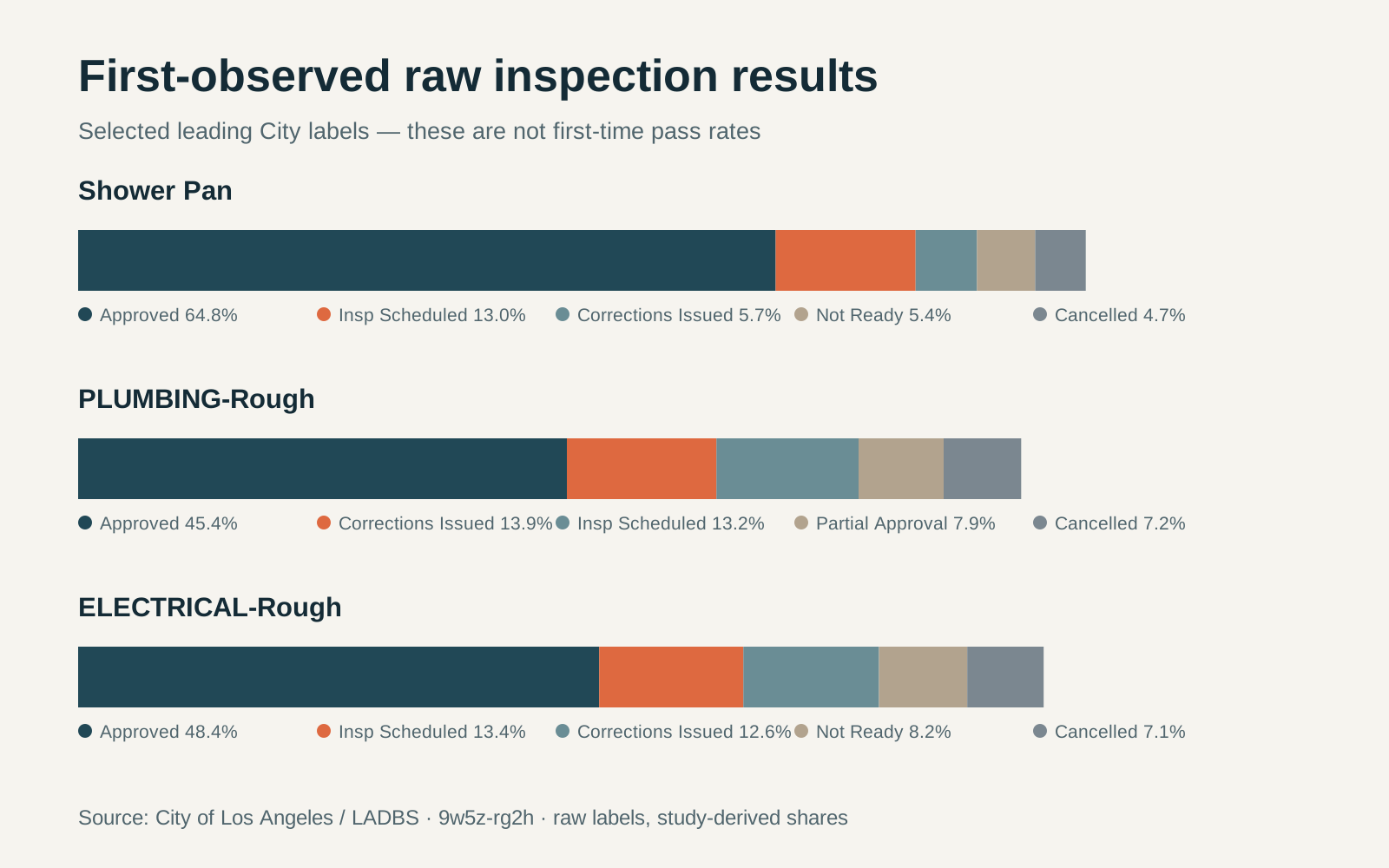
| Inspection type | Pairs | Approved | Insp Scheduled | Corrections Issued | Other leading raw labels |
|---|---|---|---|---|---|
| Shower Pan | 8,786 | 64.8% | 13.0% | 5.7% | Not Ready 5.4%; Insp Cancelled 4.7% |
| PLUMBING-Rough | 11,507 | 45.4% | 13.2% | 13.9% | Partial Approval 7.9%; Insp Cancelled 7.2% |
| ELECTRICAL-Rough | 10,305 | 48.4% | 13.4% | 12.6% | Not Ready 8.2%; Insp Cancelled 7.1% |
At least one raw "Corrections Issued" label appeared for 26.1% of Final pairs, 18.6% of PLUMBING-Rough pairs, 16.4% of ELECTRICAL-Rough pairs and 7.0% of Shower Pan pairs. These are descriptive record patterns. They are not failure rates, defect rates or measures of contractor or homeowner performance.
| Inspection type (raw label) | Permit/type pairs | Pairs with at least one "Corrections Issued" | Share |
|---|---|---|---|
| Final | 15,647 | 4,081 | 26.1% |
| PLUMBING-Rough | 11,507 | 2,144 | 18.6% |
| ELECTRICAL-Rough | 10,305 | 1,693 | 16.4% |
| Shower Pan | 8,786 | 617 | 7.0% |
Source note: City of Los Angeles / LADBS, Building and Safety Inspections (9w5z-rg2h), events on or before 2026-10-04. Study-derived indicator: whether the raw result "Corrections Issued" appears at least once among a matched permit's rows for that inspection type. Not a failure or defect rate.
Read this correctly: "Corrections Issued" is a label on a record. On its own it does not establish defective workmanship, fault or noncompliance by anyone, and these shares must not be used to rank contractors, homeowners or neighborhoods.
First result vs. any point in the record.
The same label can be counted two ways. The first-recorded-result section counted pairs whose first recorded result was "Corrections Issued." This section counts pairs where the label appears at least once. Side by side:
| Inspection type | First-observed result was "Corrections Issued" | "Corrections Issued" appears at least once |
|---|---|---|
| Shower Pan | 498 of 8,786 (5.7%) | 617 of 8,786 (7.0%) |
| PLUMBING-Rough | 1,600 of 11,507 (13.9%) | 2,144 of 11,507 (18.6%) |
| ELECTRICAL-Rough | 1,297 of 10,305 (12.6%) | 1,693 of 10,305 (16.4%) |
The "at least once" share is higher for all three types; by definition it can never be lower. The approved outputs do not isolate what accounts for the difference, so this study does not attribute it.
Source note: same City inspection source and frozen-cutoff method used in the first-recorded-result and corrections sections.
Why there is no general "repeat inspection rate".
This study does not publish a single repeat-inspection rate. The released derived outputs do not include the complete repeat-count distribution needed to compute and independently check one. Repeat behavior appears only in specific journey patterns, such as a "Final" on one date followed by another "Final" on a later date in the inspection-journeys section.
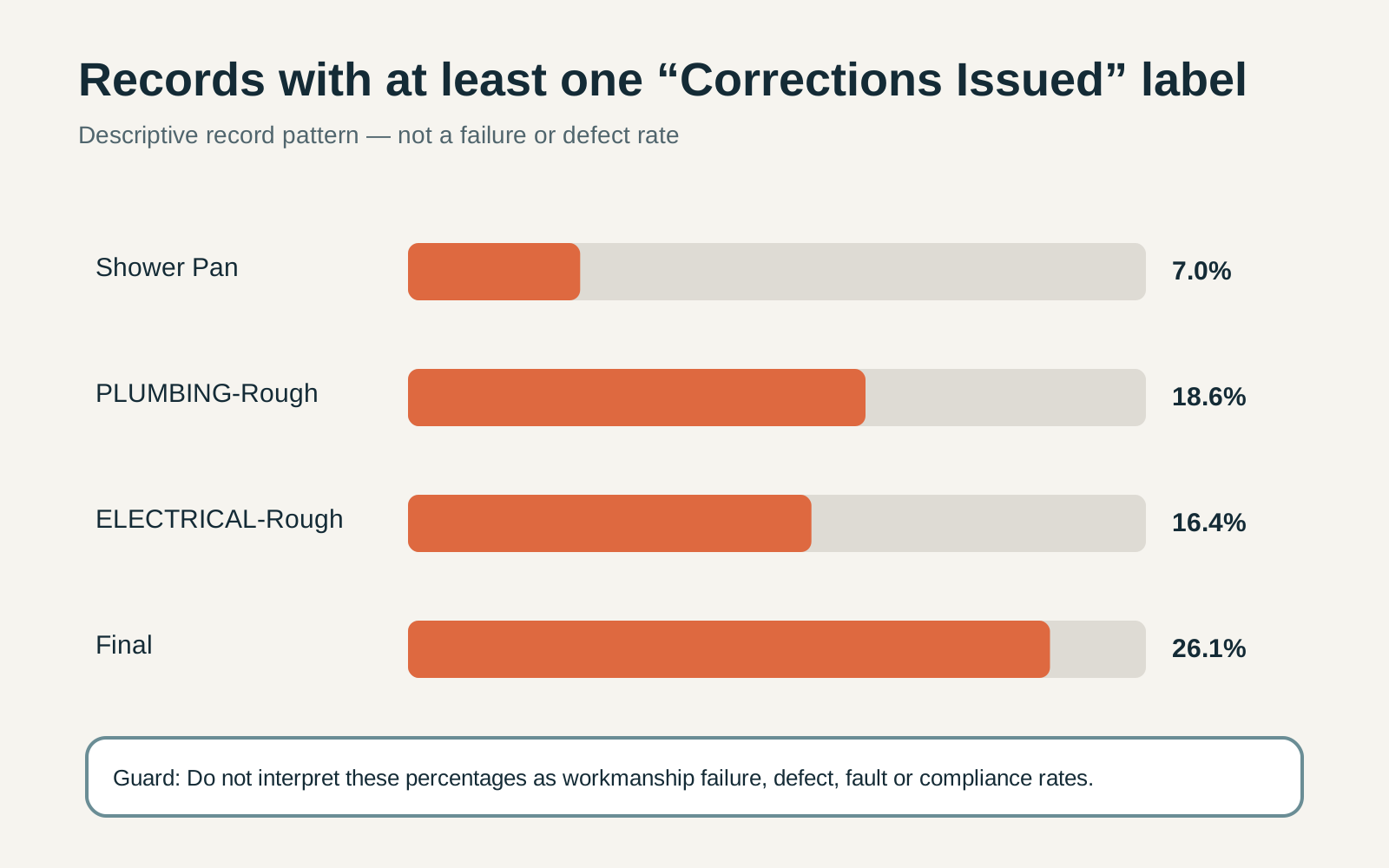
Counts are descriptive record patterns, not failure or defect rates. Denominators are stated in the surrounding copy.
| Inspection type | Pairs with Corrections Issued |
|---|---|
| Shower Pan | 617 |
| PLUMBING-Rough | 2,144 |
| ELECTRICAL-Rough | 1,693 |
| Final | 4,081 |
We turned each matched permit's inspection history into a day-level journey, the sequence of dates with the inspection types recorded on each. Among the most common shapes, a single "Final" on its own describes 508 permits. A lone "Special/Order Compliance" describes 275. Beyond the top few shapes, journeys form a long tail.
How to read the notation: each step is one inspection date. "+" joins inspection types recorded on the same date. The study works with dates, not times of day, so the order shown within a date is not meaningful. "→" separates different dates, in chronological order.
| Example rank | Journey (raw City labels) | What the notation says | Permits |
|---|---|---|---|
| 1 | Final | One inspection date; only a Final was recorded | 508 |
| 2 | Special/Order Compliance | One inspection date; only Special/Order Compliance was recorded | 275 |
| 3 | Public Counter + Special/Order Compliance | One date with both types; order within the day unknown | 162 |
| 4 | Final → Final | A Final on one date, then another Final on a later date | 157 |
| 5 | Final + SGSOV-Seismic Gas S/O Valve + Smoke Detectors | One date with all three types; order within the day unknown | 145 |
Source note: City of Los Angeles / LADBS, Building and Safety Inspections (9w5z-rg2h), events on or before 2026-10-04. Study-derived: day-level journeys built from matched permits' inspection rows. These are selected examples from the study's top-100 journey table. That table is a long-tail subset, not a complete catalogue of journeys. Journey shares are not published.
Read this correctly: These are examples, not a taxonomy. The table does not show the "standard" bathroom-remodel path, and same-day types are an unordered basket, not a sequence.
What the journeys suggest, and what they don't.
Matched permit records do not follow a single path. Some show one inspection date, some only a "Special/Order Compliance" inspection, some the same type on two dates. The data records these shapes but not the reasons behind them, and this study does not guess.
The labels "Special/Order Compliance," "Public Counter" and "SGSOV-Seismic Gas S/O Valve" are reproduced as the City records them. This study does not interpret what triggers them.
Same-day types are unordered baskets. Arrows indicate date order only. The examples come from a descriptive top-100 journey table, not an exhaustive taxonomy.
| Journey example | Permits |
|---|---|
| Final | 508 |
| Special/Order Compliance | 275 |
| Public Counter + Special/Order Compliance | 162 |
| Final → Final | 157 |
| Final + SGSOV + Smoke Detectors | 145 |
An open or non-final status, such as a mature record still reading "Issued," is a reason to verify the current official record. It is not evidence that the project is defective, abandoned or noncompliant. Among records more than 24 months old at the cutoff, 3,009 of 15,426 (19.5%) still carried "Issued" in this frozen snapshot.
| What you see on the record | What it shows | What it does not establish |
|---|---|---|
| Raw status "Issued" on an older permit | A permit was issued, and the record had not moved to "Permit Finaled" as of the record date | That the work is unfinished, abandoned, defective or noncompliant |
| Raw status "Permit Finaled" | The record carries the raw label "Permit Finaled" | The quality of the work, or anything that happened after the record date |
| A "Corrections Issued" result in the inspection list | Corrections were recorded at least once for that inspection type | Fault, defective workmanship, or whether corrections were resolved |
| No inspection rows found for a permit | In this study: no inspection row matched the permit number in the frozen snapshot | That no inspections took place |
| Many inspection dates, or the same type on several dates | Activity was recorded on multiple dates | That something went wrong |
Source note: interpretation boundaries used for this study of LADBS datasets pi9x-tg5x and 9w5z-rg2h.
Use this if you are buying a home, selling one, or checking your own past project.
This study cannot tell you what the answers will be. It can tell you that 19.5% of the mature records in this frozen cohort still carried "Issued" at the cutoff, and that the record alone does not say why.
• Read the status with the date. On a permit more than 24 months old, an "Issued" label is worth verifying against the current official record; 19.5% of the mature records in this frozen cohort carried that label at the cutoff.
• Don't treat the lifecycle medians as a construction schedule. 97 days (Tier A) and 197 days (Tier B) are paperwork intervals for completed records.
• Compare like with like. If your permit also covers a kitchen or a broader remodel, compare it with Tier B, not Tier A.
• Read inspection labels as records, not verdicts. That includes "Corrections Issued," and it includes a permit with no inspection data, which does not mean no inspections.
• Check jurisdiction first. These findings describe City of Los Angeles permits only.
This section is written for journalists, researchers and anyone checking our work before citing it.
1. Sources.
| Source | Publisher | Resource ID | Role in this study |
|---|---|---|---|
| Building Permits Issued from 2020 to Present (N) | City of Los Angeles / LADBS | pi9x-tg5x | Permit frame: permit number, issue date, status, work description, permit sub-type |
| Building and Safety Inspections | City of Los Angeles / LADBS | 9w5z-rg2h | Inspection events: permit, inspection date, inspection type, inspection result |
The permit data is a frozen snapshot. It was captured once, hashed, and not refreshed during the analysis. Inspection events are counted only if dated on or before the 2026-10-04 production cutoff, with the cutoff applied locally after retrieval.
2. Cohort and classifier.
The cohort was built by classifying the permit dataset's work-description text with a rules-based classifier. Its include, exclude and precedence rules were frozen before any headline metric was calculated. Sampled positive and negative classifications were audited row by row before approved corrections entered the frozen rules. When a broad rewrite of the rules over-corrected in one revision, it was rejected. The frozen version, v0.4, keeps an earlier stable baseline plus only explicitly adjudicated corrections, each bound to a specific permit number and work-description text. The result: 9,645 Tier A and 12,153 Tier B records, 21,798 in total.
3. Joining permits to inspections.
Permits were linked to inspection events by permit number, normalized on both sides into one key that removes presentation-only separators and whitespace without truncating any segment. Because the two datasets format permit numbers differently, the join was tested on permits already known to have inspection records before full acquisition began.
Inspection data was acquired in 436 bounded chunks covering exactly the 21,798 cohort permits. Before full acquisition, the run had to rediscover 20 of 20 known-matched "sentinel" permits, which returned 187 inspection rows on or before the cutoff. A preliminary acquisition attempt returned no inspection rows, so the final acquisition workflow required the sentinel check before full retrieval.
4. Deduplication.
The acquisition returned 203,055 inspection rows. Only exact duplicate rows were removed, 6,992 of them, leaving 196,063 rows. Distinct events on the same day were kept.
5. Matched and unmatched permits.
19,223 permits (88.2%) matched at least one inspection row on or before the cutoff. 2,575 did not. Unmatched permits stay in every cohort and status count. They are excluded only from inspection-based measures. "Unmatched" means no matched inspection row in this snapshot, not "no inspections."
6. Status, lifecycle and first-observed logic.
• Status by age: the raw status label in the permit record at the cutoff, grouped by record age. Recent and mature records are kept separate.
• Lifecycle: calendar days from issue date to the earliest inspection date whose raw result is exactly "Permit Finaled." The study validated 12,106 such lifecycle records across all record ages. The published figures use only the mature cohort (at least 24 months old) and report Tier A and Tier B separately. By design, a record whose status reads finaled but has no matched "Permit Finaled" event date stays in the status counts and is left out of the interval calculation.
• First-observed result: the raw result on the earliest inspection date for each permit/type pair. Multiple results on that date are labeled MULTIPLE_SAME_DAY instead of being ordered arbitrarily.
• Frequency, corrections and journeys: permits counted once per inspection type; "Corrections Issued" counted as present at least once per permit/type pair; journeys built by date, with same-day types as unordered baskets.
7. Right-censoring and the mature-cohort choice.
Records issued shortly before the cutoff have not had time to reach a final status, so comparing them directly with older records would mislead. The study therefore separates recent from mature records. It tested mature thresholds of 12, 18 and 24 months: the raw "Permit Finaled" share was 71.2%, 71.9% and 72.3% respectively. It uses 24 months for the published lifecycle figures.
8. Limitations.
• City of Los Angeles only. Do not generalize to Los Angeles County or to independent cities.
• Classifier-defined cohort. "Bathroom remodel" means what the frozen classifier selects from City work descriptions. Some remodels may be worded in ways it misses, and some edge cases may be misclassified despite audit.
• Raw labels and records, not outcomes or construction. No pass/fail mapping has been validated, and lifecycle intervals measure paperwork events.
• Partial itemization. Some distributions show only the most frequent labels, and only the youngest and oldest age bands are published. A general repeat-inspection rate is held.
• No cost, quality or risk measures. Declared valuation is not used as project cost, and no contractor, homeowner or neighborhood rankings are produced.
• Frozen in time. Figures describe the snapshot at the cutoff, not later changes to City records.
9. Provenance note.
This published snapshot does not include an explicit ISO-8601 retrieval start and end timestamp. Source identities, cutoff, file hashes, source metadata and the acquisition ledger are preserved. The inspection dataset's metadata snapshot reports its rows as last updated at 2026-10-05T13:02:54Z, and the analysis was produced on 2026-10-06. Any future refresh should record retrieval timestamps, with time zone, explicitly.
10. Reproducibility register.
| Reproducibility item | Recorded value |
|---|---|
| Permit source | City of Los Angeles / LADBS — Building Permits Issued, resource pi9x-tg5x (frozen snapshot) |
| Inspection source | City of Los Angeles / LADBS — Building and Safety Inspections, resource 9w5z-rg2h |
| Production cutoff | 2026-10-04 (inspection events on or before this date) |
| Classifier version | CA-LA-03-BATHROOM-CLASSIFIER-v0.4-MINIMAL-RECOVERY |
| Classifier manifest SHA-256 | 9631561e8ee241cf9c220f1a235fdaa6bdb8c7eed4b3e8d096410efbeddb4f6d |
| Production plan SHA-256 | 72b7c5e12339175ac52e0a5cf2a9cb507da7c4bcc984d11519aec2b218db0057 |
| Sanitized production package SHA-256 | e409cc289df7ffc13161b88dbfc571df95e0224cc09700911c29b5d886d9ee8d |
| Cohort | 21,798 permits (Tier A 9,645; Tier B 12,153) |
| Inspection acquisition | 436 bounded chunks; 203,055 rows before exact deduplication; 196,063 after; 6,992 exact duplicates removed |
| Join coverage | 19,223 matched (88.2%); 2,575 unmatched |
| Lifecycle records validated (all ages) | 12,106 exact "Permit Finaled" records |
| Sentinel check | 20/20 known-matched permits rediscovered; 187 rows on or before cutoff |
| Inspection metadata rowsUpdatedAt | 2026-10-05T13:02:54Z |
| Retrieval timestamp | Not serialized in production JSON (see provenance note) |
The sanitized production package keeps the hashes and row counts of every raw inspection chunk in its manifest and ledger. The raw chunk bodies are retained separately.
The record had not moved to "Permit Finaled" as of the record date. That is a reason to verify the current official record, not evidence that the work is unfinished, defective or noncompliant. In this study, 19.5% of bathroom-remodel permit records more than 24 months old still carried "Issued" at the 2026-10-04 cutoff. (LADBS pi9x-tg5x)
Among mature records with an exact "Permit Finaled" inspection result, the median gap was 97 days for bathroom-specific permits (Tier A) and 197 days for mixed or broader permits that include bathroom work (Tier B). That is a permit-record interval, not the time construction took. (LADBS pi9x-tg5x, 9w5z-rg2h)
No. It is a label on an inspection record, and on its own it does not establish defective work or fault. In this study, at least one "Corrections Issued" label appeared on 18.6% of PLUMBING-Rough and 7.0% of Shower Pan permit/type pairs. (LADBS 9w5z-rg2h)
Among 19,223 matched permits, the most common raw inspection types were Final (81.4%), Interior/Exterior Lathing (63.3%), PLUMBING-Rough (59.9%) and ELECTRICAL-Rough (53.6%). Shower Pan appeared for 45.7%. Frequency does not mean a type is required for every remodel. (LADBS 9w5z-rg2h)
The City's result labels include "Insp Scheduled," "Insp Cancelled," "Not Ready for Inspection" and "Partial Approval," which do not on their face read as pass or fail, and no validated mapping exists. "Approved" was the first raw result for 45.4% of PLUMBING-Rough pairs, but that is not a pass rate. (LADBS 9w5z-rg2h)
Not necessarily. 2,575 of the 21,798 permits in this study had no matched inspection row in the frozen snapshot. That is a data-join result; unmatched does not mean no inspection activity occurred. (LADBS pi9x-tg5x ↔ 9w5z-rg2h)
No. It covers 21,798 permit records from the City of Los Angeles Department of Building and Safety only. Other cities in Los Angeles County, and areas permitted by the County, are outside its scope. (LADBS pi9x-tg5x)
Suggested citation:
Bath Remodeling Los Angeles. Los Angeles Bathroom Remodel Permits: What City Records Show About Inspections and Final Sign-Off. Data: City of Los Angeles Department of Building and Safety, resources pi9x-tg5x and 9w5z-rg2h, data frozen October 4, 2026. https://bathremodelinglosangeles.com/resources/los-angeles-bathroom-remodel-permit-inspection-study/.
Quoting a figure? Copy-ready statements that keep the guard attached:
• "Among City of Los Angeles bathroom-remodel permit records more than 24 months old, 72.3% carried the raw status 'Permit Finaled' and 19.5% still carried 'Issued' at the October 4, 2026 data cutoff. These are status labels, not completion odds."
• "Among mature City of Los Angeles bathroom-remodel permit records (at least 24 months old) with an exact 'Permit Finaled' result, the median permit-record lifecycle, from issue date to that result, was 97 days for bathroom-specific permits and 197 days for mixed-scope permits that include bathroom work. That is a records interval, not construction time."
• "Among 15,647 matched City of Los Angeles bathroom-remodel permits with a Final inspection, 26.1% had at least one 'Corrections Issued' label for that inspection type. This is a record pattern, not a failure or defect rate."
• "Final inspections were recorded for 81.4% of 19,223 matched City of Los Angeles bathroom-remodel permits. Frequency does not mean an inspection type is required for every remodel."
Please keep the scope ("City of Los Angeles"), the cutoff date and the guard wording when you quote.
| Study section | Published figure | Value | Scope or denominator | Source | Interpretation |
|---|---|---|---|---|---|
| Cohort definition | Study cohort | 21,798 | City of Los Angeles permit records, cutoff 2026-10-04 | pi9x-tg5x | Study-derived classification |
| Cohort definition | Tier A records | 9,645 | Study cohort | pi9x-tg5x | Study-derived classification |
| Cohort definition | Tier B records | 12,153 | Study cohort | pi9x-tg5x | Study-derived classification |
| Methodology and reproducibility | Matched permits | 19,223 (88.2%) | 21,798 | pi9x-tg5x ↔ 9w5z-rg2h | Data-join coverage |
| Methodology and reproducibility | Unmatched permits | 2,575 | 21,798 | pi9x-tg5x ↔ 9w5z-rg2h | Data-join coverage |
| Permit status by age | Records 0–6 months old | 1,858 | Study cohort | pi9x-tg5x | Study-derived |
| Permit status by age | 0–6 months: raw "Permit Finaled" | 545 (29.3%) | 1,858 | pi9x-tg5x | Raw label, derived share |
| Permit status by age | 0–6 months: raw "Issued" | 1,293 (69.6%) | 1,858 | pi9x-tg5x | Raw label, derived share |
| Permit status by age | Records more than 24 months old | 15,426 | Study cohort | pi9x-tg5x | Study-derived |
| Permit status by age | More than 24 months: raw "Permit Finaled" | 11,155 (72.3%) | 15,426 | pi9x-tg5x | Raw label, derived share |
| Permit status by age | More than 24 months: raw "Issued" | 3,009 (19.5%) | 15,426 | pi9x-tg5x | Raw label, derived share |
| Permit status by age | Tier A, more than 24 months: raw "Permit Finaled" | 5,036 (75.5%) | 6,674 | pi9x-tg5x | Raw label, derived share |
| Permit status by age | Tier B, more than 24 months: raw "Permit Finaled" | 6,119 (69.9%) | 8,752 | pi9x-tg5x | Raw label, derived share |
| Permit status by age | Raw "Permit Finaled" share, records ≥12 months | 71.2% | Records at least 12 months old | pi9x-tg5x | Sensitivity check |
| Permit status by age | Raw "Permit Finaled" share, records ≥18 months | 71.9% | Records at least 18 months old | pi9x-tg5x | Sensitivity check |
| Permit status by age | Raw "Permit Finaled" share, records ≥24 months | 72.3% | Records at least 24 months old | pi9x-tg5x | Sensitivity check |
| Permit-record lifecycle | Tier A lifecycle: n / 25th pct / median / 75th pct | 4,179 / 58.5 / 97 / 179 days | Mature records with exact "Permit Finaled" | pi9x-tg5x + 9w5z-rg2h | Permit-record lifecycle |
| Permit-record lifecycle | Tier B lifecycle: n / 25th pct / median / 75th pct | 5,379 / 113 / 197 / 357.5 days | Mature records with exact "Permit Finaled" | pi9x-tg5x + 9w5z-rg2h | Permit-record lifecycle |
| Inspection frequency | Final | 15,647 (81.4%) | 19,223 matched permits | 9w5z-rg2h | Permits with type |
| Inspection frequency | Interior/Exterior Lathing | 12,161 (63.3%) | 19,223 | 9w5z-rg2h | Permits with type |
| Inspection frequency | PLUMBING-Rough | 11,507 (59.9%) | 19,223 | 9w5z-rg2h | Permits with type |
| Inspection frequency | ELECTRICAL-Rough | 10,305 (53.6%) | 19,223 | 9w5z-rg2h | Permits with type |
| Inspection frequency | Drywall Nailing | 8,934 (46.5%) | 19,223 | 9w5z-rg2h | Permits with type |
| Inspection frequency | Shower Pan | 8,786 (45.7%) | 19,223 | 9w5z-rg2h | Permits with type |
| Inspection frequency | Smoke Detectors | 7,712 (40.1%) | 19,223 | 9w5z-rg2h | Permits with type |
| First recorded result | Shower Pan first result: Approved / Insp Scheduled / Corrections Issued / Not Ready for Inspection / Insp Cancelled | 64.8% / 13.0% / 5.7% / 5.4% / 4.7% | 8,786 pairs | 9w5z-rg2h | Raw labels, first observed |
| First recorded result | PLUMBING-Rough first result: Approved / Corrections Issued / Insp Scheduled / Partial Approval / Insp Cancelled | 45.4% / 13.9% / 13.2% / 7.9% / 7.2% | 11,507 pairs | 9w5z-rg2h | Raw labels, first observed |
| First recorded result | ELECTRICAL-Rough first result: Approved / Insp Scheduled / Corrections Issued / Not Ready for Inspection / Insp Cancelled | 48.4% / 13.4% / 12.6% / 8.2% / 7.1% | 10,305 pairs | 9w5z-rg2h | Raw labels, first observed |
| Corrections patterns | At least one "Corrections Issued": Final | 4,081 (26.1%) | 15,647 pairs | 9w5z-rg2h | Descriptive indicator |
| Corrections patterns | At least one "Corrections Issued": PLUMBING-Rough | 2,144 (18.6%) | 11,507 pairs | 9w5z-rg2h | Descriptive indicator |
| Corrections patterns | At least one "Corrections Issued": ELECTRICAL-Rough | 1,693 (16.4%) | 10,305 pairs | 9w5z-rg2h | Descriptive indicator |
| Corrections patterns | At least one "Corrections Issued": Shower Pan | 617 (7.0%) | 8,786 pairs | 9w5z-rg2h | Descriptive indicator |
| Inspection journeys | Journey: Final | 508 permits | Selected from top-100 journey table | 9w5z-rg2h | Day-level journey |
| Inspection journeys | Journey: Special/Order Compliance | 275 permits | Selected from top-100 journey table | 9w5z-rg2h | Day-level journey |
| Inspection journeys | Journey: Public Counter + Special/Order Compliance | 162 permits | Selected from top-100 journey table | 9w5z-rg2h | Day-level journey |
| Inspection journeys | Journey: Final → Final | 157 permits | Selected from top-100 journey table | 9w5z-rg2h | Day-level journey |
| Inspection journeys | Journey: Final + SGSOV-Seismic Gas S/O Valve + Smoke Detectors | 145 permits | Selected from top-100 journey table | 9w5z-rg2h | Day-level journey |
All figures: City of Los Angeles / LADBS open data, frozen snapshot, cutoff 2026-10-04. Counts and shares are study-derived. Raw labels are reproduced exactly.
Data cutoff: October 4, 2026. This is a frozen snapshot study. Its figures will change only if a new snapshot passes a fresh classifier review and Fact/Claim review.
Continue with Bathroom Remodeling Resources, the Bathroom Remodeling FAQ, or compare Shower Remodeling, Tub-to-Shower Conversion and Walk-In Showers.
The research above is intended to stand on its own as planning context. If you are planning a qualifying project, you can call (866) 332-0433.